Why the AGIBOT X2 won Gear Culture’s Best Robotics award at MWC 2026

Every year at MWC, a handful of humanoid robots shuffle across demo stages while handlers hover nearby, ready to catch them if something goes wrong. The machines take cautious, pre-programmed steps, pause between gestures, and move with a stiffness that betrays how close they are to falling over. It’s impressive in the way that watching a toddler walk is impressive: you’re rooting for them, but you wouldn’t trust them with anything.
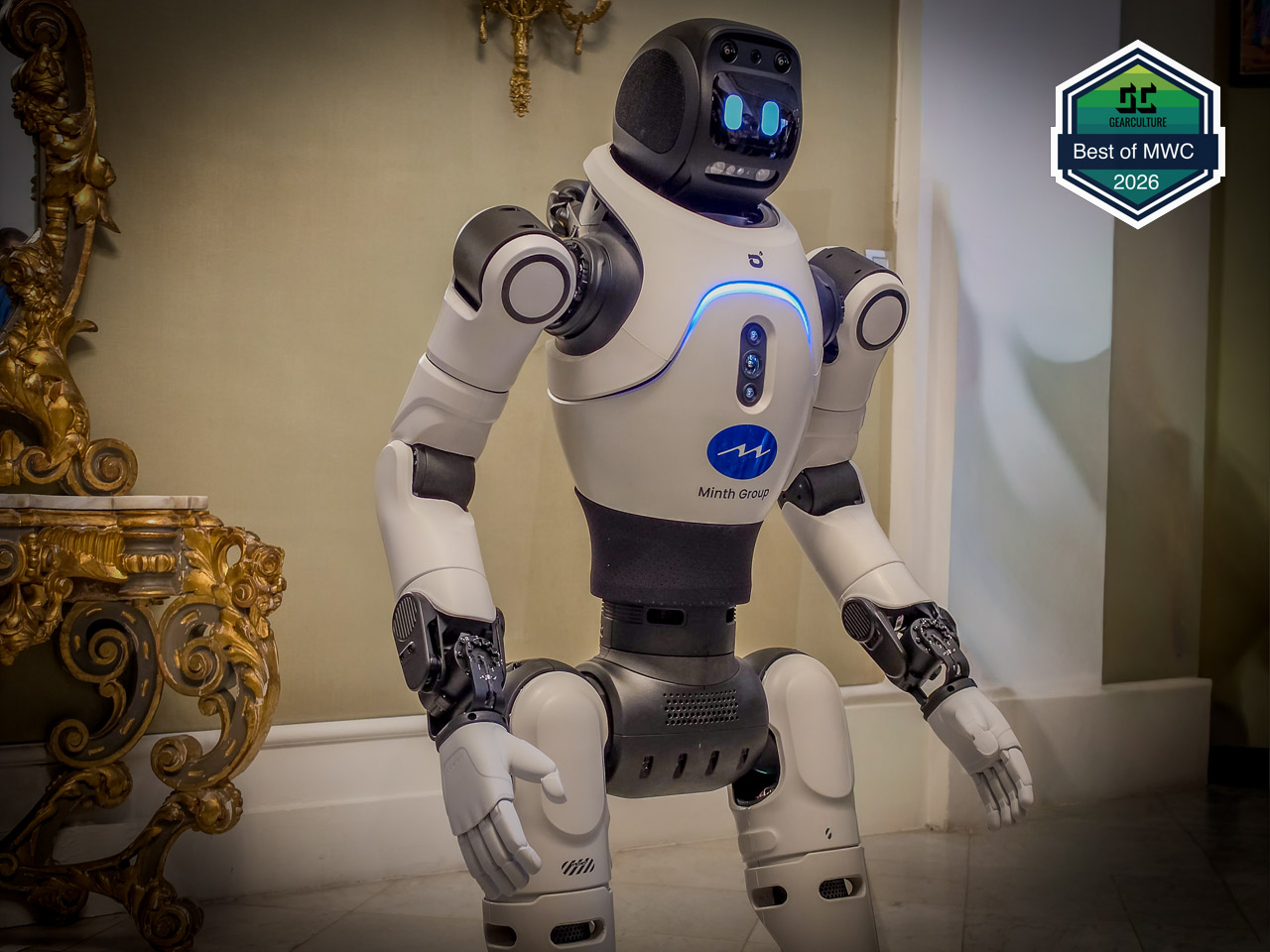
The AGIBOT X2 broke that pattern completely. At MWC 2026 in Barcelona, this four-foot-four humanoid dropped into a full split on the show floor, performed coordinated dance routines with fluid transitions, and navigated through crowds with a smoothness that stopped attendees mid-conversation. That’s why Gear Culture selected it as the Best Robotics product at this year’s show.
What makes the X2 different from every other humanoid at MWC
Movement is where the conversation starts and where most competitors lose it. The AGIBOT X2 Ultra runs 30 degrees of freedom across its body, with 7 DOF per arm, 3 DOF in the waist, 6 DOF per leg, and a single neck DOF that lets the head track conversations independently from the torso. Even the base model packs 25 DOF, which still exceeds what most show floor humanoids were working with in Barcelona.
What those numbers translate to in practice is the gap between robotics and movement. The X2 doesn’t just walk. It performs complex dance sequences where the arms, torso, and legs coordinate in real time, producing motion that reads as choreographed rather than pre-scripted. The head follows the rhythm independently. The waist rotates mid-stride. You can see the difference from across a crowded exhibition hall.
Peak joint torque hits 120 Nm, so each movement carries genuine force behind it. Arm reach extends 558 mm excluding end effectors, giving the X2 enough range to hand objects to seated adults, gesture toward signage or exhibits, and execute the sweeping arm movements that make its dance routines look fluid rather than constrained.
Then there’s speed. Maximum walking velocity reaches 1.8 meters per second, with lab conditions pushing that to 2.0 m/s. For reference, the average human walking speed is about 1.4 m/s. The X2 can literally outpace you on a sidewalk, which is a strange thing to type about a four-foot robot but there it is.
Physically, the X2 occupies a deliberate size category at 1,310 mm tall and roughly 35 kg (39 kg for the Ultra). It’s tall enough to maintain natural eye contact with a seated adult, compact enough to weave through a crowded mall corridor, and light enough that its presence near children or elderly visitors doesn’t feel like a liability. The exterior wraps in a soft, skin-friendly material that makes accidental contact feel intentional, like bumping into a person wearing a padded jacket rather than a cold machine.
The sensor stack that powers autonomous operation
Most humanoid robots define “autonomy” as following a pre-mapped path without hitting walls. The X2 Ultra redefines the term entirely.
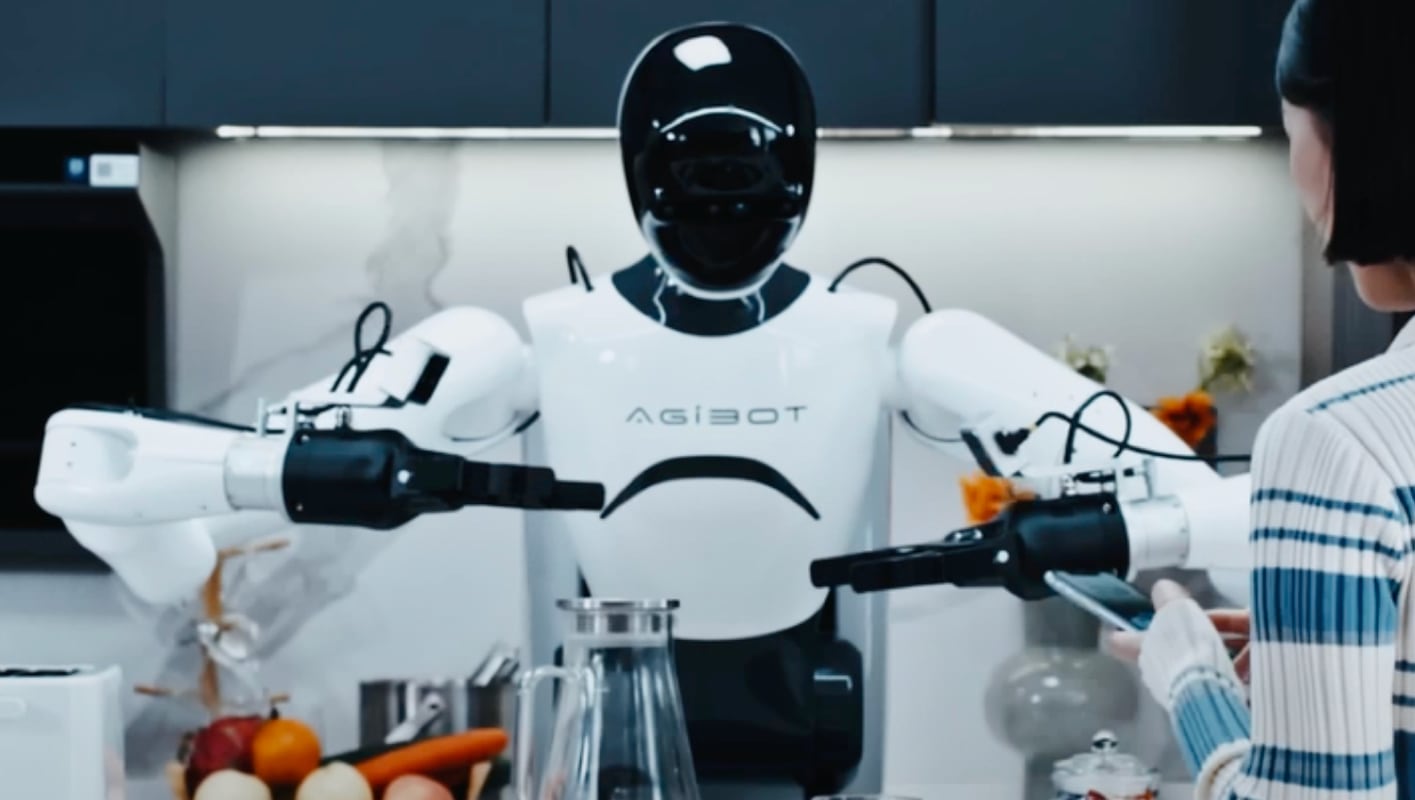
Its perception system stacks 3D LiDAR for high-precision positioning and SLAM, RGB-D cameras for depth-aware spatial understanding, front stereo vision for forward obstacle detection, and rear monocular vision for coverage behind the robot. These aren’t isolated systems running in parallel. They feed into a unified environmental model that updates in real time, giving the X2 spatial awareness that extends in every direction simultaneously.
Computing power and the Ultra advantage
Both models run dual RK3588 processors as their main compute backbone, handling locomotion, sensor fusion, and interaction logic. The Ultra variant layers an NVIDIA Orin NX module on top, adding 157 TOPS of compute performance. That’s the same class of edge AI silicon found in autonomous vehicle platforms and industrial robotics rigs. The X2 Ultra pairs the Orin NX with an expanded perception suite, added connectivity including 4G and 5G cellular modules, and support for third-party secondary development.
The I/O ecosystem on the Ultra is built for integrators and developers. Dual RJ45 Ethernet ports handle wired network connections for venues that demand rock-solid latency. A Mini DisplayPort output enables external monitoring or signage displays. Four USB ports (two Type A, two Type C) provide expansion for peripherals, custom sensors, or third-party hardware modules. The base X2 keeps it simpler with one Type A and one Type C port and no wired networking options.
The wireless split tells you who each model is built for. The base X2 ships with Wi-Fi and Bluetooth, enough for controlled environments with solid network infrastructure. The Ultra adds 4G and 5G cellular modules, keeping the robot online in venues where Wi-Fi coverage can’t be guaranteed. If you’re deploying somewhere that dropped connections mean a robot standing frozen in the middle of a museum tour, the Ultra is the only configuration that makes practical sense.
Already deployed, already working
Here’s where the AGIBOT X2 story diverges from every other humanoid robot at MWC 2026. This isn’t a prototype. It isn’t a carefully managed demo unit that lives in a shipping crate between trade shows. The X2 is a commercial product with an active supply chain, and the deployment numbers back that up.
AGIBOT says it rolled out its 5,000th mass-produced humanoid robot by early 2026, and Omdia estimated 5,168 humanoid shipments for the company in 2025.
Those units are deployed across eight commercial application areas: guided reception and exhibition services, entertainment and commercial performances, intelligent manufacturing, logistics sorting, security inspection, commercial cleaning, data collection training, and scientific research and education.
Operational autonomy extends to power management on the Ultra. When battery levels drop below threshold, the X2 Ultra automatically navigates to its dedicated charging station and docks itself without human intervention. For businesses running the Ultra across full-day shifts, that means the unit manages its own energy cycle from morning startup to evening shutdown. The base X2 does not support automatic charging and requires manual battery swaps or quick-swap packs.
The rental model makes adoption even more accessible. At MWC 2026, AGIBOT launched a Robot-as-a-Service program with one-day minimum rentals starting at €899, a figure widely described in English-language coverage as about $1,000 per day. With the base X2 listed at $24,240, a business can bring in a unit for a product launch, a weekend pop-up, or a two-week trial at a fraction of the purchase price. That pricing structure opens the door to industries that would never greenlight a capital expenditure on humanoid robotics but can justify a daily rental line item.
Credibility runs deeper than sales figures, though. AGIBOT’s A2 line set the Guinness World Record for the longest journey walked by a humanoid robot at 106.286 kilometers, a sustained endurance benchmark that speaks directly to the reliability of the company’s mechanical systems, battery architecture, and control algorithms. The X2 shares the same engineering lineage, built on lessons from that endurance program.
From the show floor to the Spring Festival stage
MWC 2026 wasn’t the first time the X2 drew a crowd. Ahead of Lunar New Year, AGIBOT staged its own live gala featuring more than 200 humanoid robots, using the event as a public showcase for synchronized dance, martial arts, and other performance routines. The choreography demanded precise timing, coordinated multi-robot movement, and the kind of dynamic balance that few bipedal platforms can sustain.
Two months before Barcelona, the X2 appeared at CES 2026 in Las Vegas. That dual-show strategy across both consumer electronics and mobile communications signals something important about where AGIBOT sees this product going: not a niche lab curiosity, but a commercial platform positioned across hospitality, retail, entertainment, and education simultaneously.
On the MWC show floor itself, social media told the story. Clips of the X2 dancing, splitting, and interacting with attendees flooded Instagram and YouTube within hours of the show opening. The consensus from everyone who saw it up close was consistent and emphatic: this robot moves differently than anything else in its weight class, and the gap isn’t subtle.
Two models, one platform
The X2 lineup splits into a standard model and the Ultra. The base X2 ships with 25 degrees of freedom, a single interactive RGB camera, Wi-Fi and Bluetooth, and the dual RK3588 compute stack. It’s built for straightforward deployment scenarios where multimodal interaction matters more than full autonomous navigation.
The Ultra pushes every dimension further. Degrees of freedom jump to 30 by adding a neck DOF and expanding each arm from 5 to 7 DOF, which dramatically improves gestural expressiveness and manipulation capability. The full sensor suite (3D LiDAR, RGB-D cameras, front stereo vision, rear monocular vision) comes standard. The NVIDIA Orin NX compute module handles the additional processing load, and 4G/5G connectivity keeps the robot online in venues where Wi-Fi coverage can’t be guaranteed.
Secondary development support on the Ultra is the sleeper feature. It opens the platform to custom applications, meaning a museum can build its own narration engine, a retailer can integrate the robot with inventory systems, and an event company can script bespoke routines. The optional auto-charging dock, paired with a dedicated charging station, seals the deal for continuous Ultra operation, letting the robot return to its station when battery drops below threshold and resume service after charging, no human intervention required.
Both variants share the same 500 Wh battery built around a quick-swap architecture. Pop the depleted pack out, slide a charged one in, and the robot resumes operation immediately. No tools, no recalibration, no downtime. Charge time runs under 90 minutes per pack, with roughly 2 hours of walking at 0.5 m/s per cycle.
Software stays current through over-the-air updates pushed to the fleet, and a mobile app gives operators remote monitoring and control when they aren’t physically on-site. The operating temperature range spans -10°C to 40°C, covering indoor climate-controlled venues year-round and most outdoor deployments across three seasons. That range matters for tourist attractions, outdoor malls, and exhibition spaces where seasonal temperature swings would sideline a less robust platform.
The multimodal interaction system
Movement gets people’s attention. Interaction is what makes the X2 useful after the novelty fades. AGIBOT designed the platform around four distinct interaction modes: visual, voice, tactile, and facial expression. Each channel runs independently, but the system’s real strength comes from blending all four in real time so the robot can read a situation the way a person would, through multiple senses at once.
The interactive RGB camera anchors the visual channel. It handles facial recognition, object detection, gesture recognition, and what AGIBOT calls environmental semantic perception, which means the robot interprets not just that someone is present but what they’re doing, where they’re looking, and how they’re moving. Voice input comes through a dedicated microphone array paired with a wireless mic option for noisy environments where a single pickup would struggle. Tactile input registers through the head touch sensor. Touch the top of the X2’s head and it nods or shakes in response, a small detail that consistently surprises people who try it because the reaction feels instinctive rather than programmed.
Output runs through dual stereo speakers mounted on each side, a front-facing interactive screen, and a programmable lighting system that shifts patterns based on interaction state. During a greeting, the lights pulse warmly. In active dialogue, they hold steady. On idle standby, they dim to a soft glow that signals availability without demanding attention. The screen handles visual communication: maps, product information, directional cues, and dynamic content that updates based on conversation context.
The facial expression display sits above the screen and adds emotional texture to every response. It conveys enthusiasm during a product recommendation, acknowledgment when a visitor asks a question, and attentiveness during longer exchanges. The expressions sync with voice output from the speakers, creating a communication loop that runs both directions. Visitors don’t need to lean in, shout, or tap a screen. The microphone array and wireless mic handle pickup in crowded, noisy venues, and the expression display confirms visually that the robot heard and understood.
For a museum tour, that means the X2 can greet a returning visitor by name, notice them pointing at an exhibit, deliver relevant background information without being prompted, and adjust pacing based on whether the group seems engaged or restless.
That’s a different category than walking smoothly. Plenty of robots can walk. Very few can read a room and respond to it.
In retail settings, the interaction layer turns the robot from a novelty into a functional employee that can direct traffic, answer product questions, and escalate complex requests to human staff without breaking conversational flow. In museum and exhibition deployments, the four-mode interaction system lets the X2 serve as a guide that adapts to its audience in real time, slowing its narration pace for older visitors, responding to children’s gestures with animated expressions, and switching languages mid-tour when the microphone array picks up a different one.
Why Gear Culture picked the X2
The best robotics product at a trade show isn’t always the most technically ambitious prototype behind a velvet rope. It’s the one furthest along the path from concept to real-world impact while still advancing what the category can do. Gear Culture has always evaluated MWC products on that balance of innovation, execution, and commercial readiness.
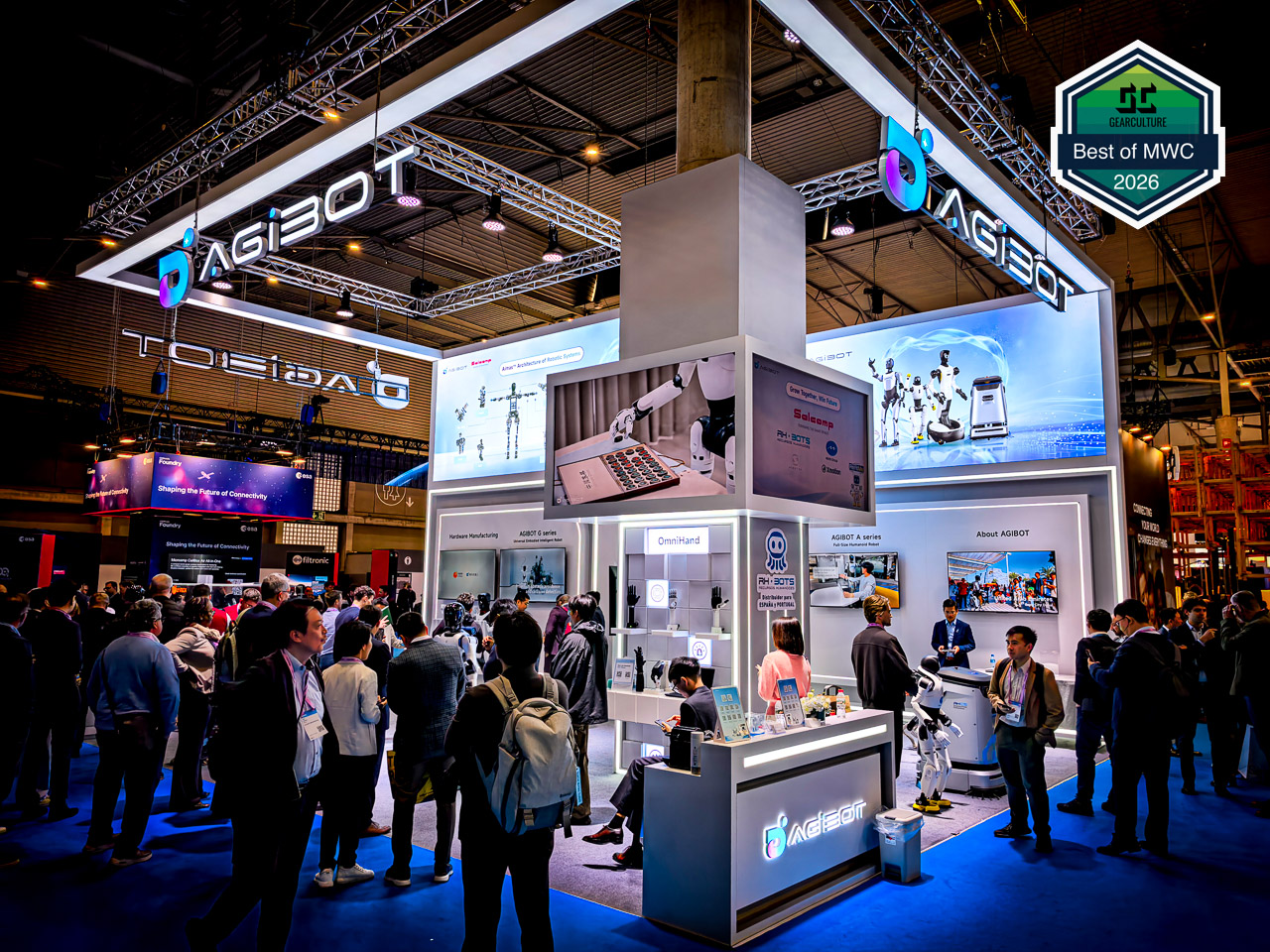
The AGIBOT X2 dominated on all three fronts. Movement quality that’s genuinely best-in-class among commercially available humanoid robots. A sensor and compute stack on the Ultra that rivals platforms costing five to ten times more. And real-world deployment at commercial scale (thousands of units across the AGIBOT portfolio in active commercial deployments, with the A2 line’s endurance benchmarks exceeding 100 kilometers) that proves the platform works outside the carefully controlled demo bubble.
The rental model is the final piece. Through a Robot-as-a-Service program starting at €899 per day, AGIBOT makes humanoid robotics accessible to businesses that couldn’t justify the $24,240 base purchase price, turning the X2 from a flagship product into an entire market category. That combination of performance, scale, and accessibility is why the AGIBOT X2 takes Gear Culture’s Best Robotics award home from MWC 2026 in Barcelona. More details at AGIBOT’s homepage.