2026 Nissan Frontier Pro-4X Review: The Last Honest Daily Driver
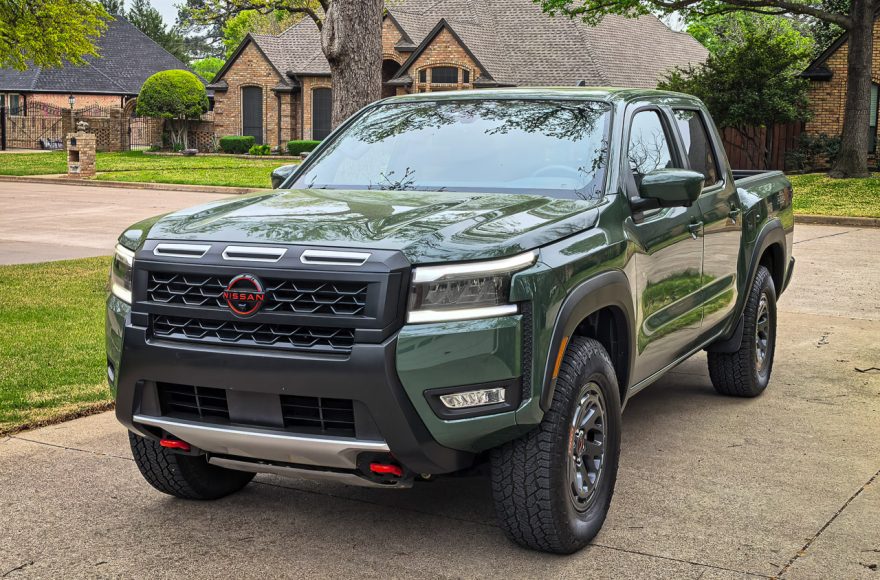
Every truck in this class has gone turbo. The segment is currently obsessed with hybrid torque, high-speed desert-jumping suspension, and burying basic functions inside three sub-menus of a touchscreen. Then there is the 2026 Nissan Frontier Pro-4X. It sits in the corner with its naturally aspirated V6, physical buttons, and a complete disinterest in following the pack.
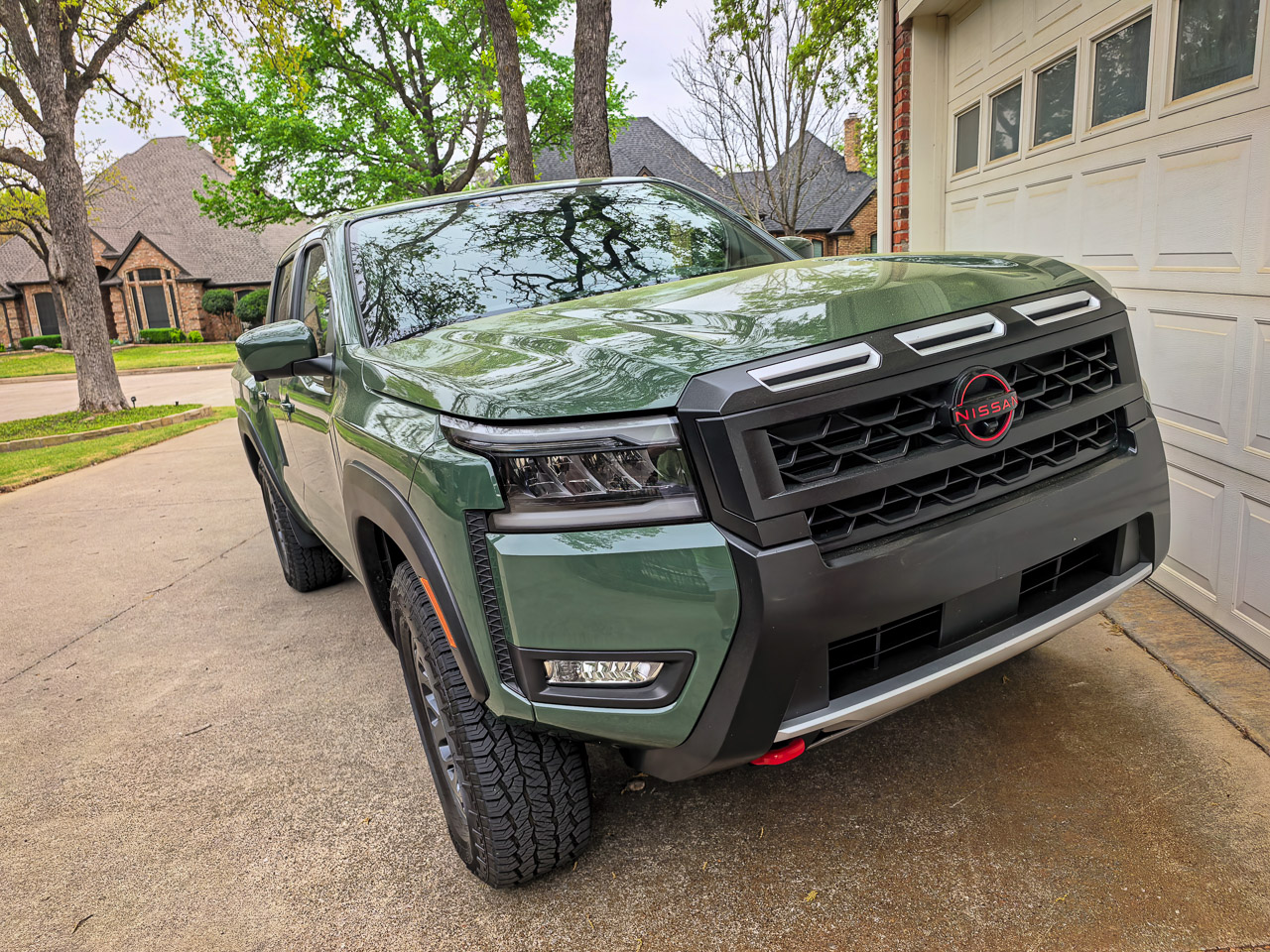
That stubbornness is exactly what makes it worth your attention. Not because it conquers trails (though it can), but because it conquers something far more important: the daily grind.
What the Pro-4X Actually Is
The 2026 Frontier Pro-4X is now the flagship of Nissan’s truck lineup, the brand’s only truck since the full-size Titan was discontinued in 2024. It runs a 3.8-liter V6 producing 310 horsepower and 281 lb-ft of torque, mated to a 9-speed automatic and a part-time four-wheel drive system you engage with a physical dial on the center console. That 310 hp figure matters most when you’re merging onto a crowded interstate or passing a semi on a two-lane highway, and the V6 delivers it without turbo lag, without hesitation, and without drama.
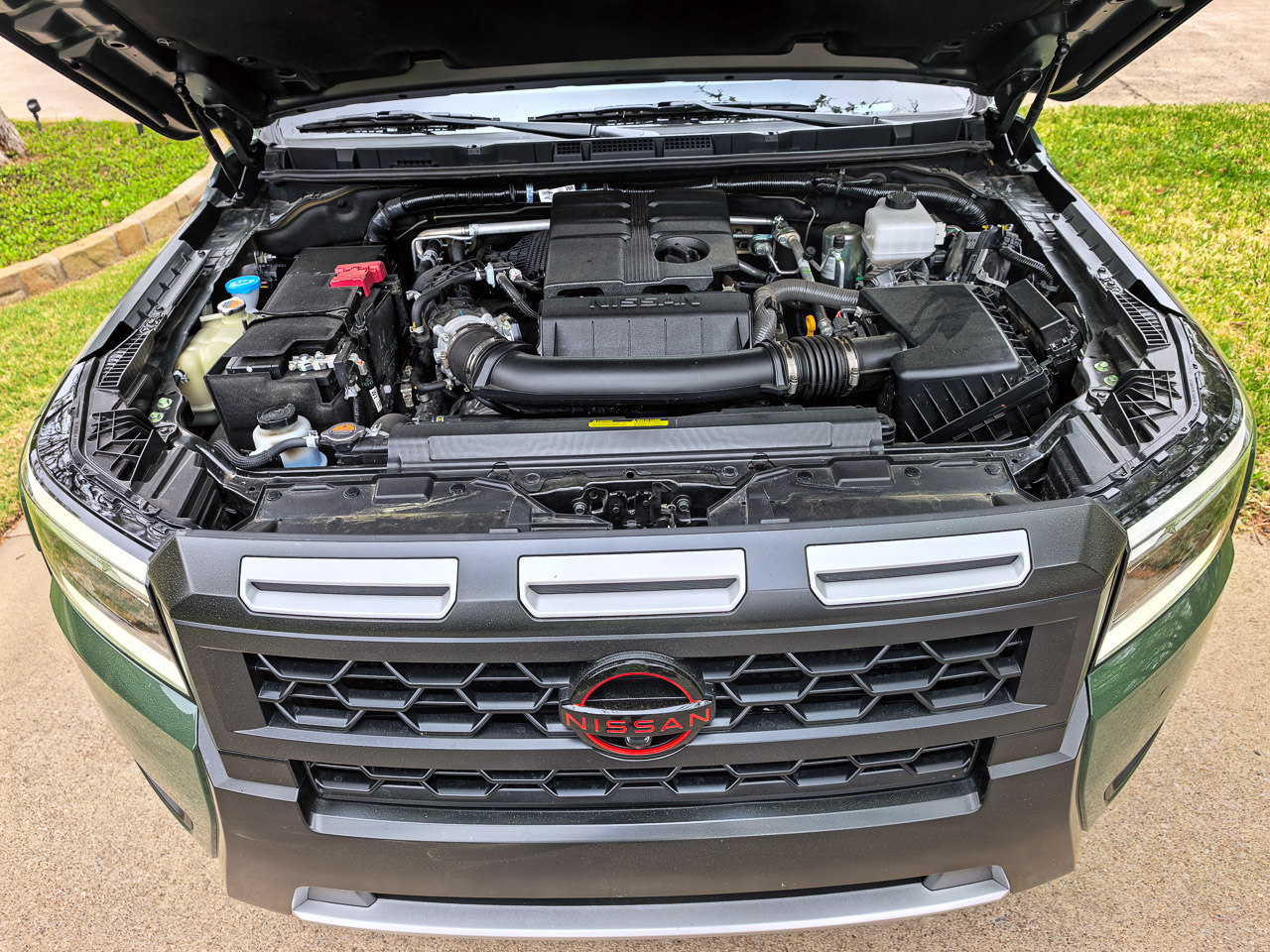
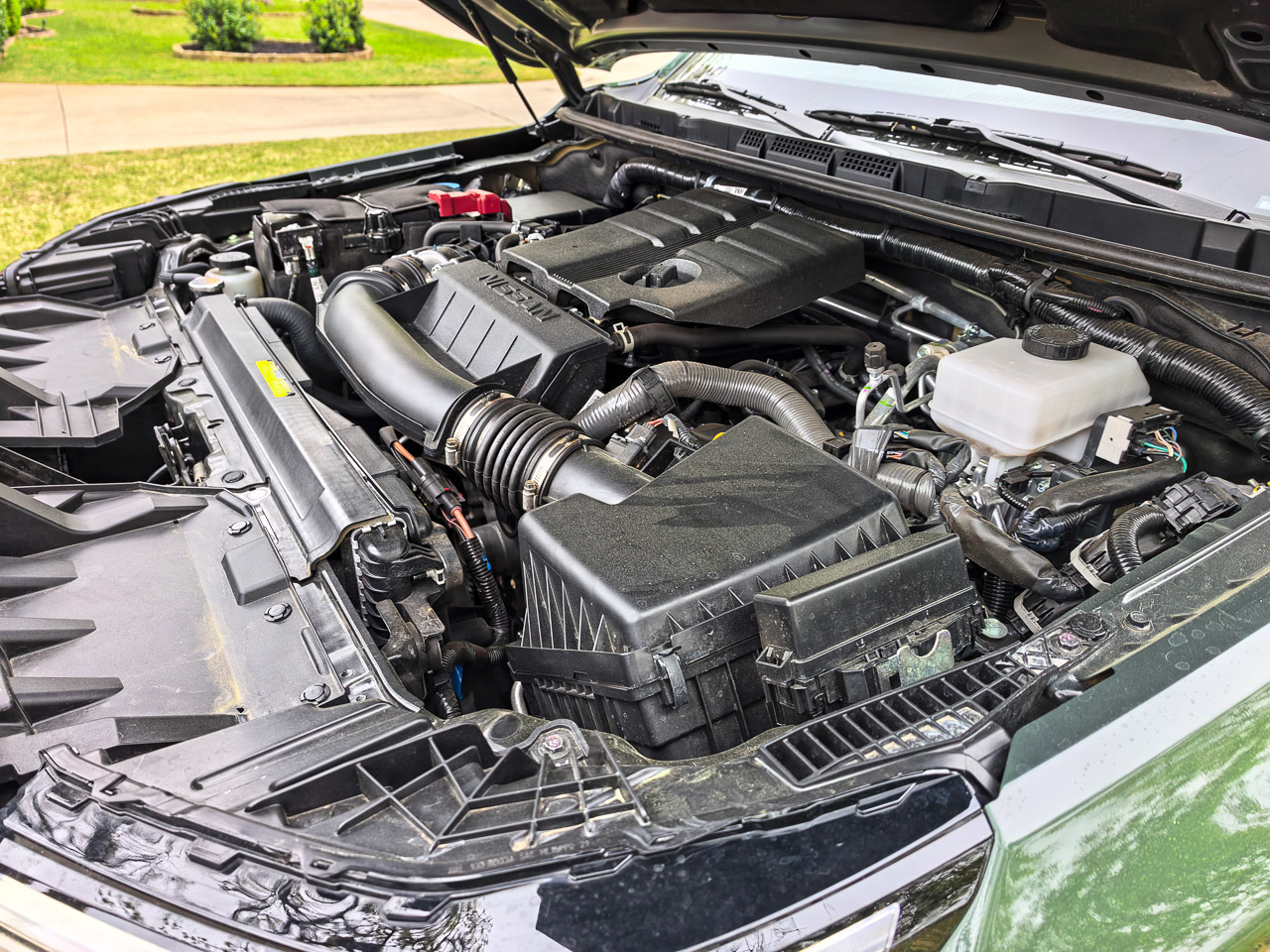
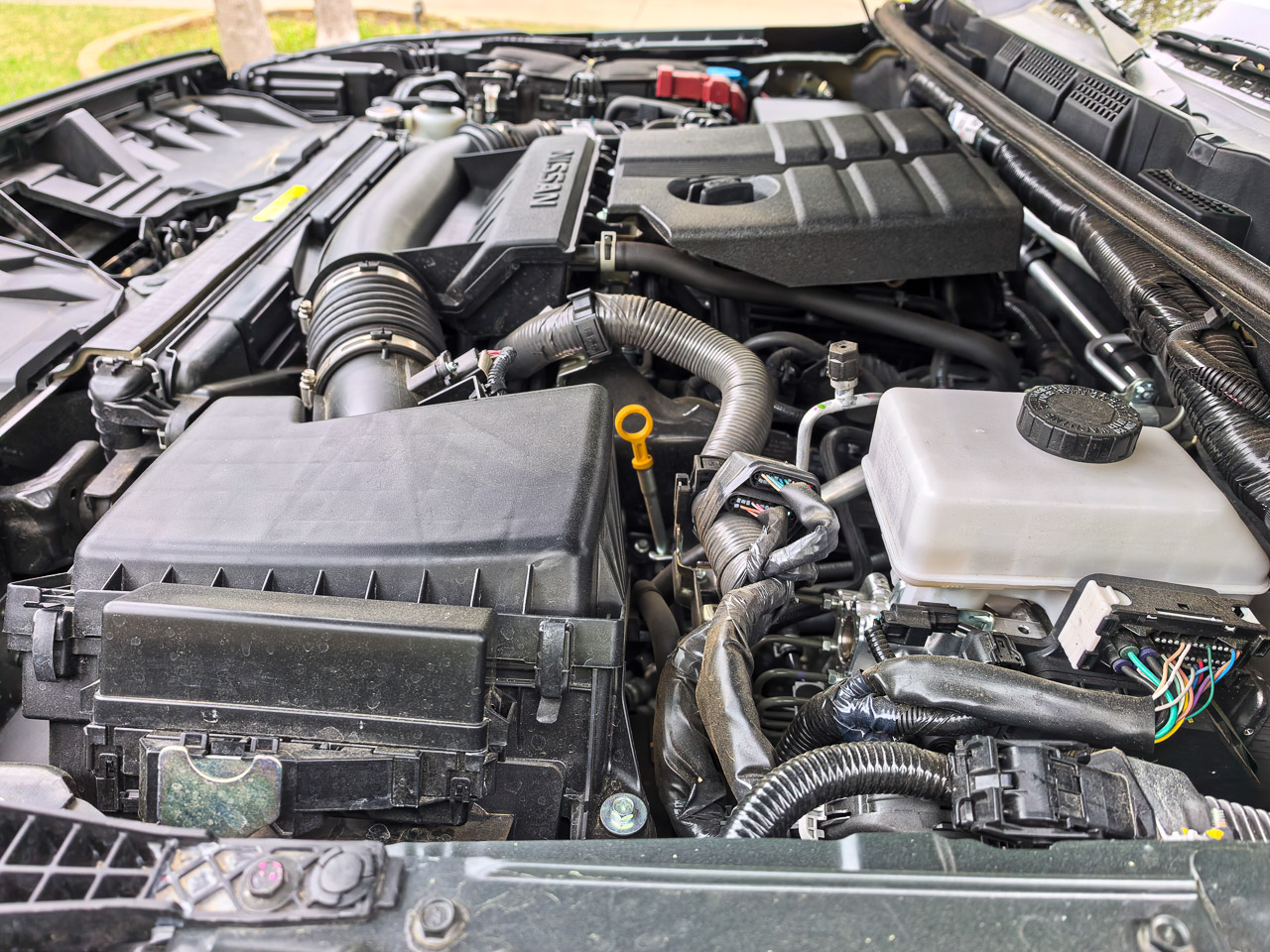
For the daily driver, the Pro-4X’s equipment list reads differently than the brochure suggests. Bilstein shocks become pothole insurance. Steel skid plates become undercarriage protection for curbed parking lots and construction zones. All-terrain Hankook tires on 17-inch alloy wheels become winter-weather confidence on unplowed suburban streets. The Drive Mode Selector, a 2026 upgrade over the previous model, includes Rock, Sand, and Mud settings for the occasional adventure, but the real daily value lives in the On-Road and Tow modes. On-Road smooths out throttle mapping for stop-and-go traffic, making the 9-speed transmission feel noticeably more decisive at low speeds than the 2025 model. Tow mode firms up shift points for confident, stable hauling. The whole truck wears a stance that reads purposeful without trying too hard.
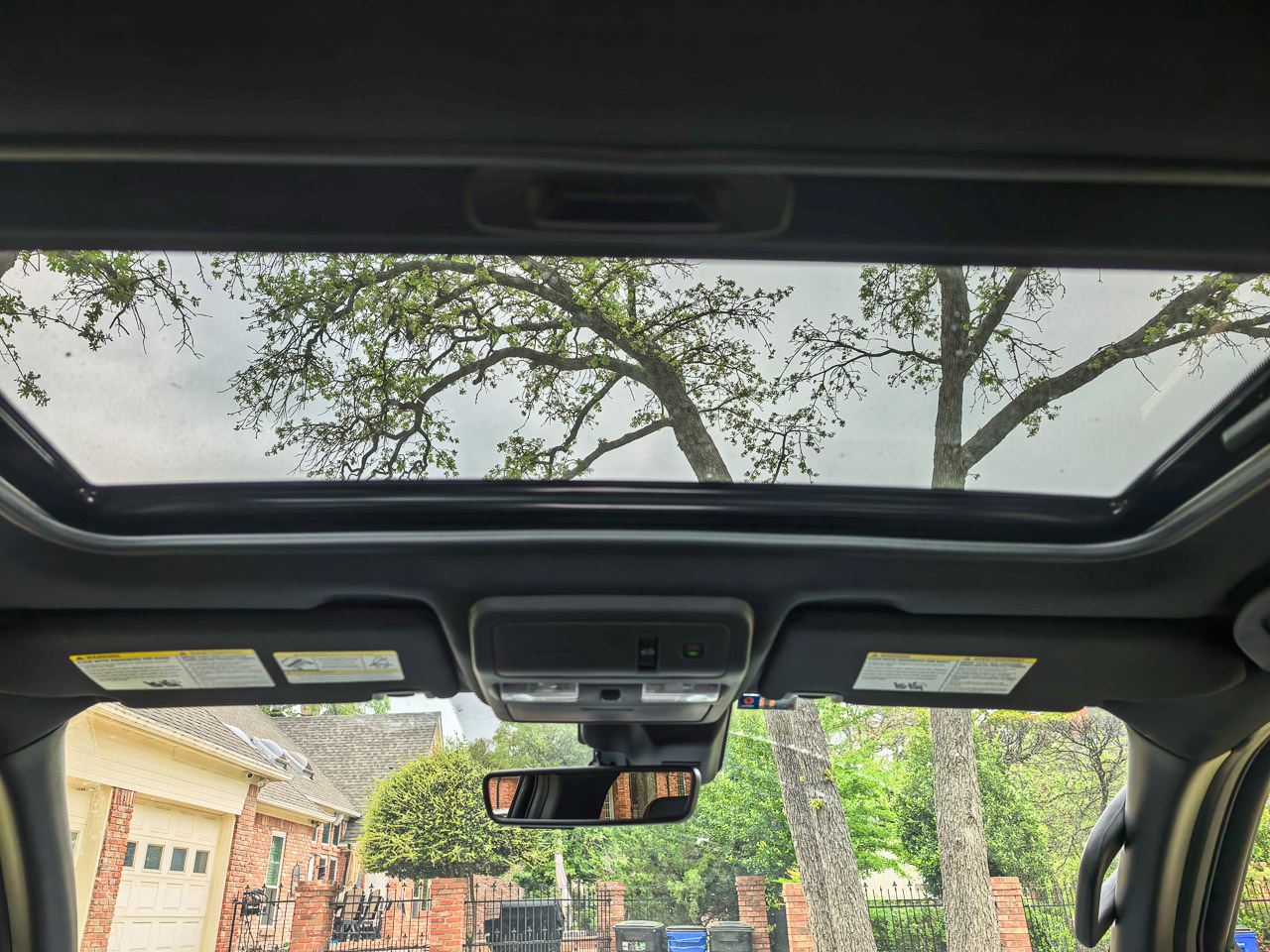
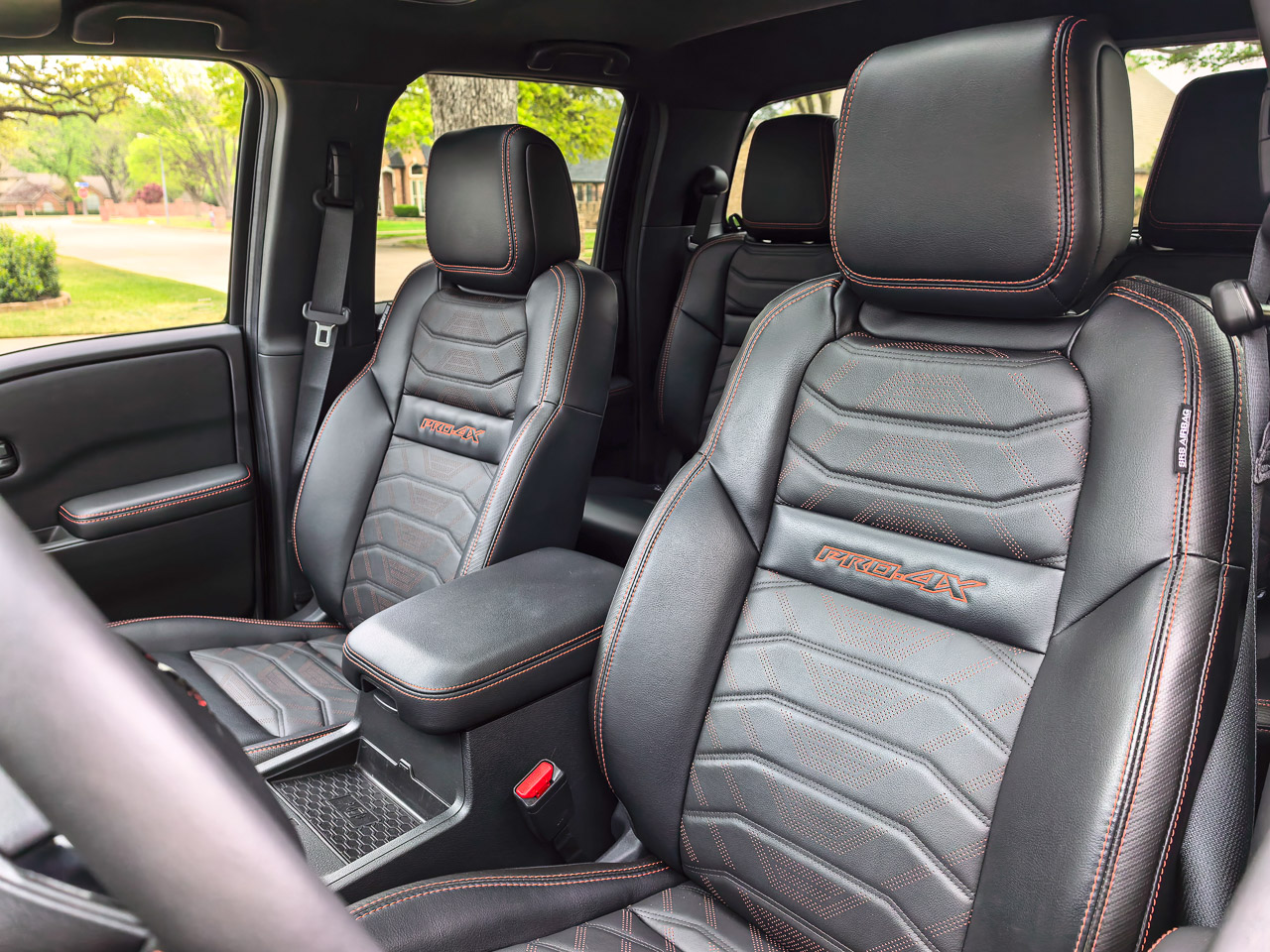
Base price for the Pro-4X lands at $41,870. Load it up with the Pro Convenience and Pro Premium packages (bedliner, Utili-Track cargo system, Fender audio, leather seats, sunroof, navigation) and you’ll land around $48,735 before destination. That’s real money, but it’s still several thousand less than a comparably equipped Tacoma TRD Pro or Colorado ZR2.
The “Daily Driver” Hardware
Most midsize truck reviews focus on what happens when you leave the pavement. This one focuses on what happens when you never do.
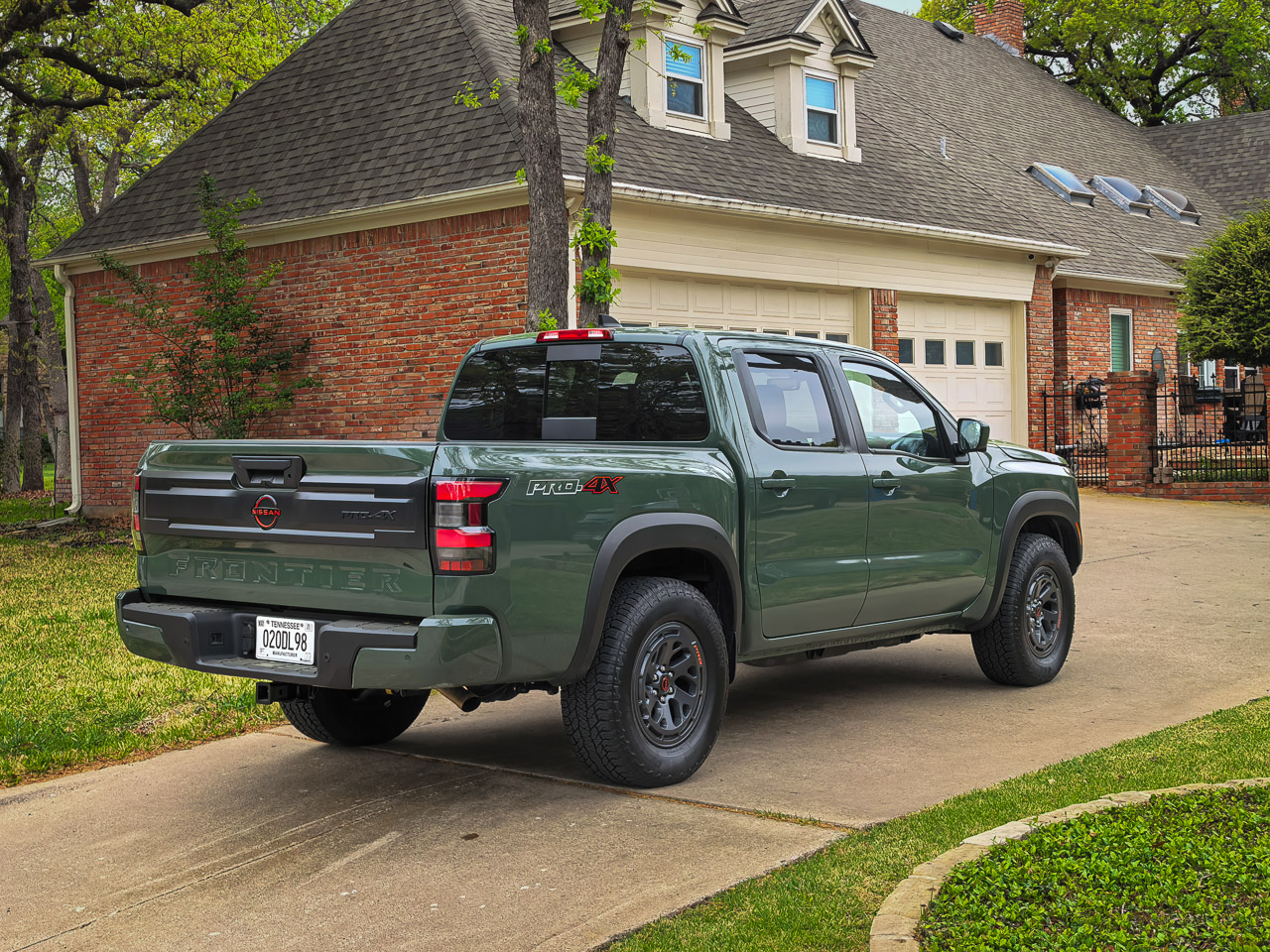
The Bilstein shocks that Nissan spec’d for the Pro-4X were designed for washboard trails and rocky fire roads. What nobody talks about is how brilliantly they handle the real obstacles most truck owners face: potholes, expansion joints, frost-heaved asphalt, and the cratered parking lots of every strip mall in America. While other midsize trucks feel hollow and jittery when the bed is empty, the Frontier feels like a solid, heavy-duty tool that can handle a lifetime of salt-belt winters and crumbling city infrastructure. It absorbs mid-corner bumps on a highway cloverleaf without jittering. It doesn’t bounce over railroad crossings. It feels like it’s made of one solid piece of iron.
The steel skid plates aren’t protecting you from boulders. They’re protecting your oil pan from that chunk of concrete in the Costco parking garage that you can never seem to avoid. The Intelligent Around View Monitor (Nissan’s 360-degree camera system) isn’t a parking gimmick. It’s the difference between clipping a curb in a crowded grocery store lot and threading this 210-inch truck into a compact spot without a scratch. Every piece of the Pro-4X’s “off-road” hardware translates directly into over-built durability for the daily grind, and that’s a more honest selling proposition than any trail-riding marketing photo.
For buyers who want the Pro-4X’s substance without the loud orange accents, the new-for-2026 Dark Armor package swaps in blacked-out 17-inch alloy wheels, dark exterior trim, and subdued badging. It’s the tactical, city-first aesthetic that lets the truck blend into a downtown parking garage instead of screaming “trail rig” at every stoplight.
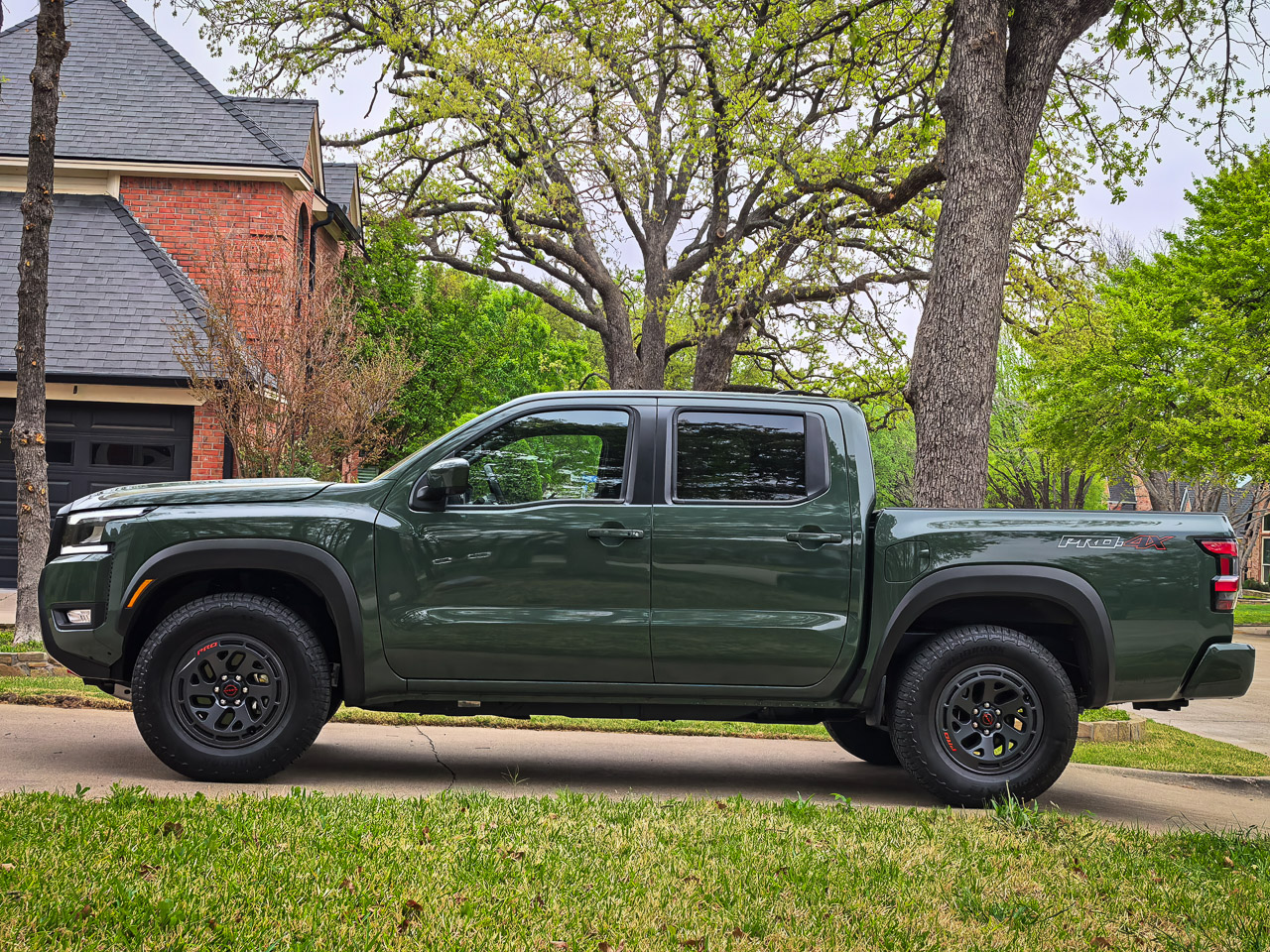
Body-on-frame midsize trucks usually punish you with a choppy, jarring experience when the bed is empty. The Frontier absorbs expansion joints and rough pavement with a composure that rivals some crossovers. Highway cruising is quiet, too. Wind and tire noise stay muted enough that you can hold a normal conversation without raising your voice, and the optional Fender audio system sounds legitimately good for a truck cabin.
Behind the Wheel: The Commuter Reality
In the city, the Frontier is an old-school beast. That hydraulic steering is heavy at the 5-mph crawl of a school pickup line and a genuine workout in tight Target parking lots. However, the 360-degree camera system is the unsung hero here, making it easy to slot this 210-inch-long truck into tight spots that would otherwise require a three-point turn. Once you’re out of the parking lot and onto a winding commuter backroad, that steering weight transforms into a source of confidence that modern electric racks can’t replicate. It’s the kind of trait that frustrates you in the first hour and wins you over by the end of the first week.
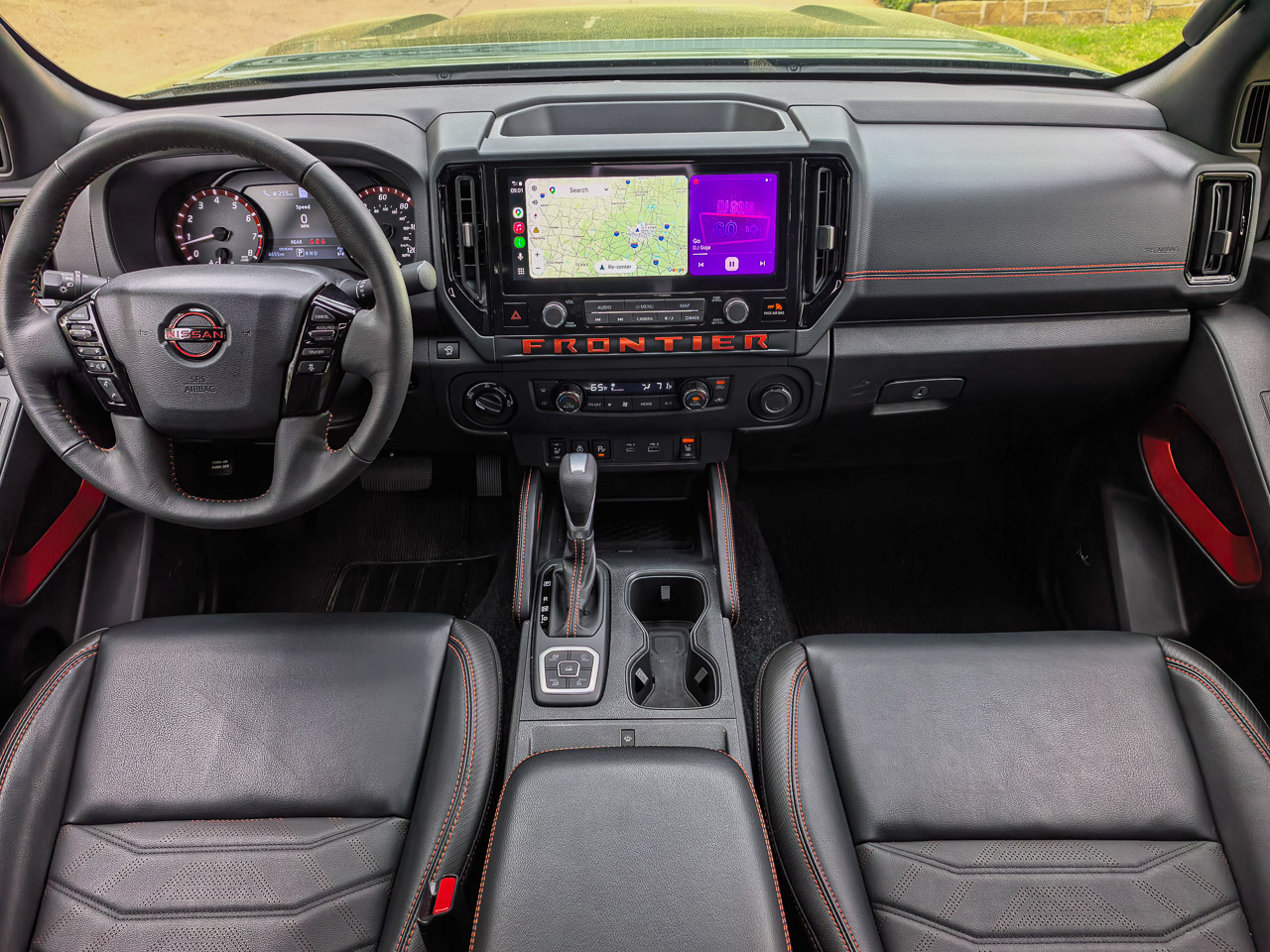
On the highway, the V6’s linear power is a breath of fresh air. When you need to pass a semi, the 9-speed automatic drops a gear and the truck just moves. There’s no waiting for a turbocharger to wake up, no hesitation while boost builds, no surge as forced induction kicks in. You press the throttle, the truck goes. The 9-speed shifts smoothly enough that you’ll rarely notice it hunting for gears, and the immediate, linear acceleration feels honest in a way turbo engines sometimes don’t.
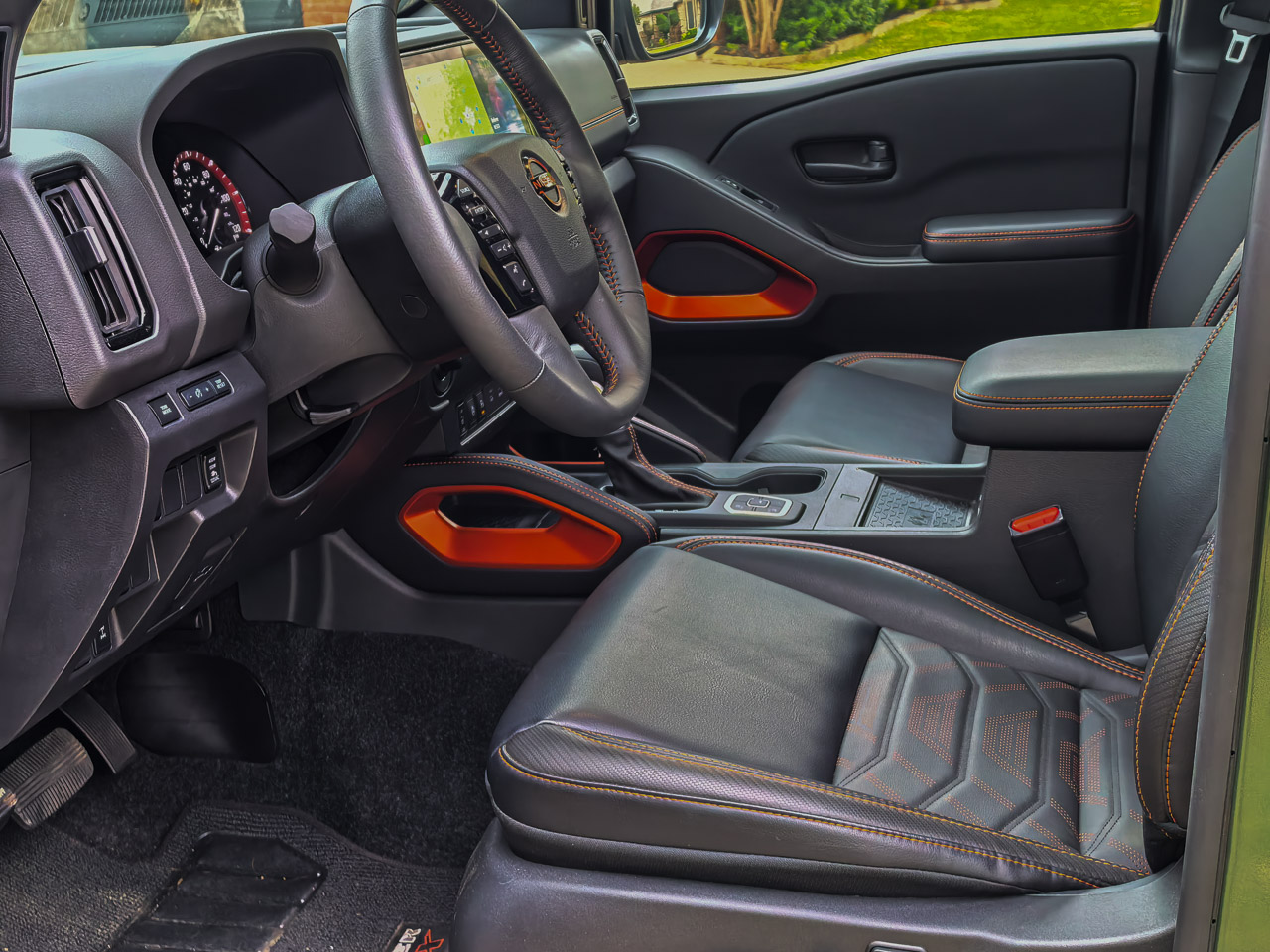
For years, we complained about the fixed steering column. The addition of the telescoping steering wheel (introduced in the 2025 refresh) finally makes this truck comfortable for drivers over 6 feet tall, a massive win for anyone who spends 45 minutes each way on a highway commute. That single change turned the Frontier from a truck I wanted to like into one I could actually live with as a daily driver.
We spent zero time on the dirt and all our time on the asphalt, and the biggest takeaway is how planted the Pro-4X feels. Those Bilstein shocks, while designed for dirt, do an incredible job of soaking up mid-corner bumps on a highway cloverleaf. It doesn’t jitter like an empty truck. It feels like it’s made of one solid piece of iron.
Simple power comes with a “V6 tax.” In a week of grocery runs, school drop-offs, and highway passing, we averaged 16.4 MPG. If you’re looking for hybrid efficiency, look elsewhere; you pay at the pump for the sake of mechanical simplicity, and that’s a trade-off you need to be honest with yourself about before signing.
The Cabin as a Sanctuary
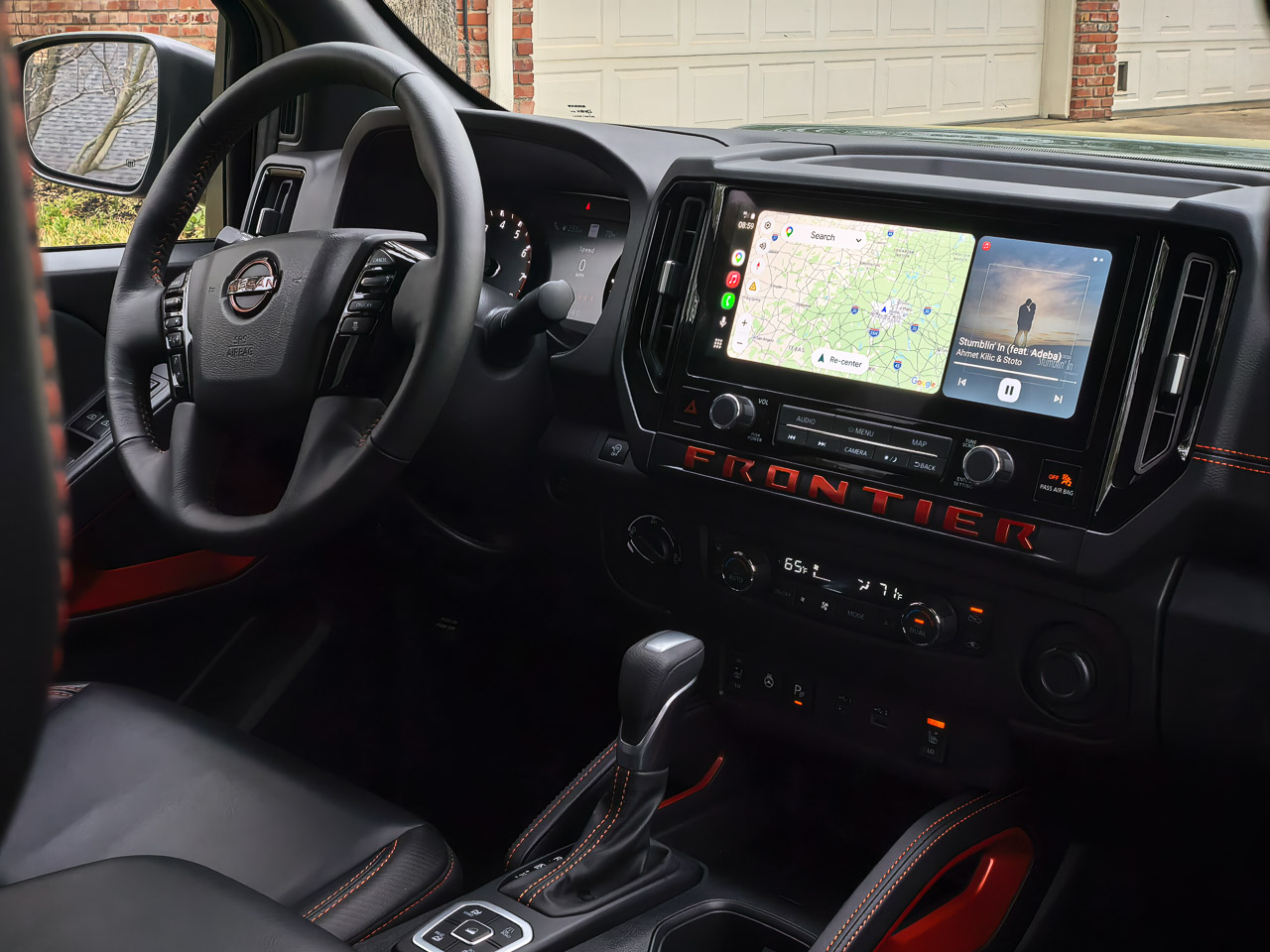
The interior is where the Frontier earns its keep as a daily driver. While the 12.3-inch touchscreen handles navigation and wireless Apple CarPlay with ease, the primary controls remain physical. Climate dials you can grab with gloves on. A drive mode selector you can feel without looking. Volume and tuning knobs for the audio system. In a world where every competitor is burying basic functions inside touchscreen menus, the Frontier lets you adjust your heat, change a radio station, and shift into four-wheel drive without taking your eyes off the road. That’s not nostalgia. That’s smart design for the 7:30 AM commute when you’re navigating morning traffic with a coffee in one hand.
The numbers back up the experience: 9.5 inches of ground clearance, a 32.3-degree approach angle, and a 54.42:1 crawl ratio put the Pro-4X squarely in competitive territory for factory off-road trucks. Steel skid plates protect the undercarriage without adding excessive weight. This isn’t a high-speed desert runner meant for jumping dunes. The Frontier won’t match a Ranger Raptor in high-speed desert running or a Colorado ZR2’s sophistication over technical rock sections. But for overlanding, where you’re carrying 400 lbs of gear and just need to get to a remote campsite, the Frontier feels more trustworthy than its more “digitized” rivals. It does the work without asking you to manage it through a screen.
If you want to push further, Nissan now offers the Roush-tuned PRO-4X R. Built just 7 miles from Nissan’s Canton assembly plant at a dedicated Roush facility, the PRO-4X R adds Ohlins remote-reservoir shocks with external reservoirs, a 2-inch front lift (1-inch rear), forged upper control arms, and Hankook Dynapro AT2 XTreme tires (one step above the standard AT2s). The package starts around $47,960, a $6,090 premium over the standard Pro-4X. Every Roush modification is covered under the factory Nissan warranty through your local dealer, which eliminates the warranty anxiety that comes with aftermarket suspension work. For context, Toyota’s TRD Off-Road Premium Package alone costs $9,220, which pushes a Tacoma past $54,000 before adding comparable capability.
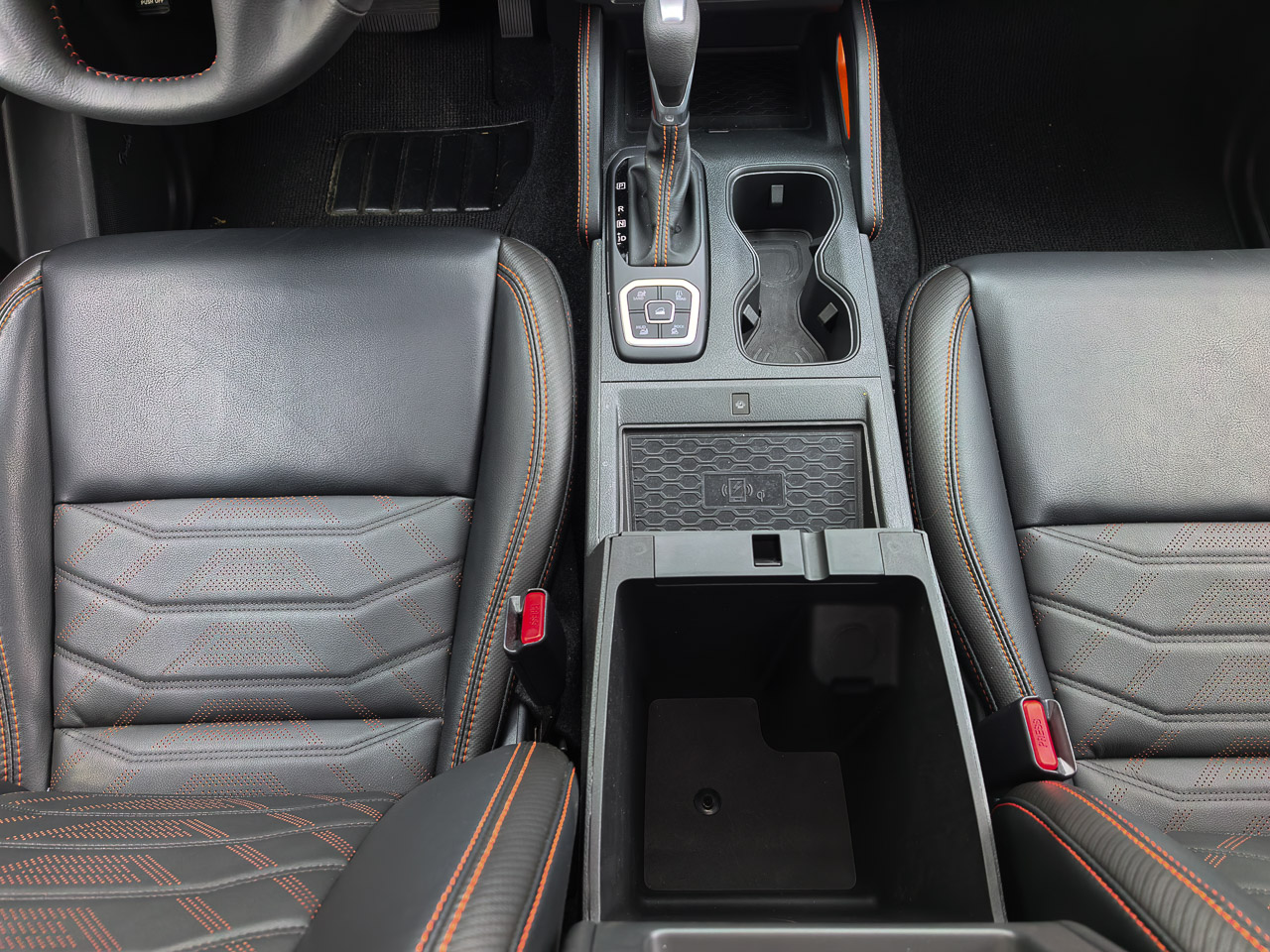
The rear seat remains tight for adults. If you’re hauling a crew of four grown men, prepare for some negotiation regarding legroom. Kids and gear bags work fine. Two six-foot adults behind two six-foot adults will require compromise. The rear seat folds up to reveal a useful storage area underneath, and USB-C ports plus a 110-volt outlet keep everyone’s devices charged during the ride.
Utili-Track for the Everyman
One of the Frontier’s most underappreciated features is the Utili-Track Channel System in the bed. Four channels with adjustable cleats let you tie down, section off, and organize whatever you’re hauling without bungee cords, ratchet straps, or the prayer method.
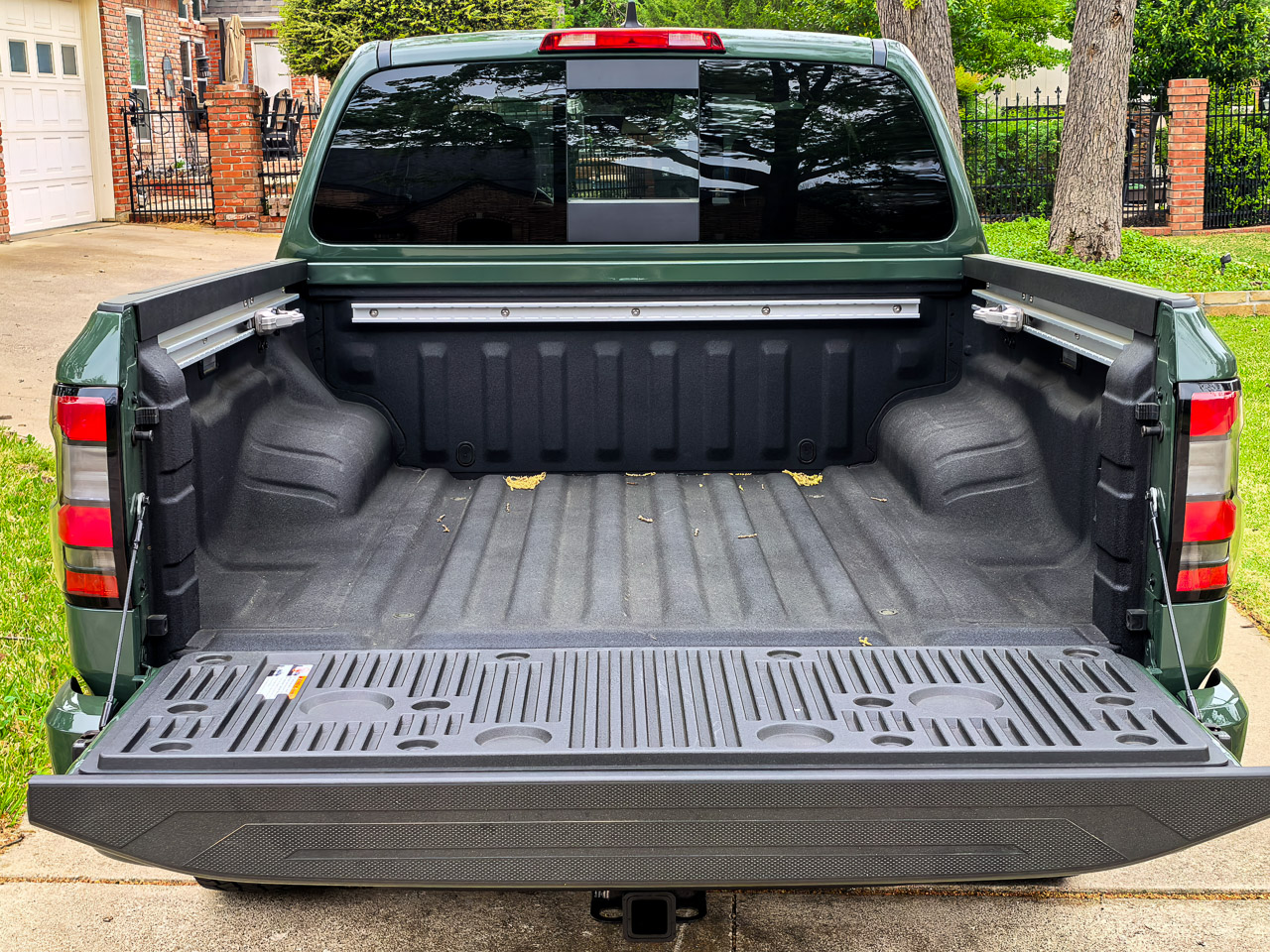
In practice, this turns the bed into the ultimate “Target run” hack. Sliding cleats keep loose gear from becoming projectiles during a spirited highway merge. Coolers stay put. Hardware store bags don’t tip over. Sports equipment doesn’t pile into the tailgate every time you brake. It’s the kind of system that sounds minor on paper but becomes indispensable the first time you load up for a weekend without having to re-stack everything at every stoplight.
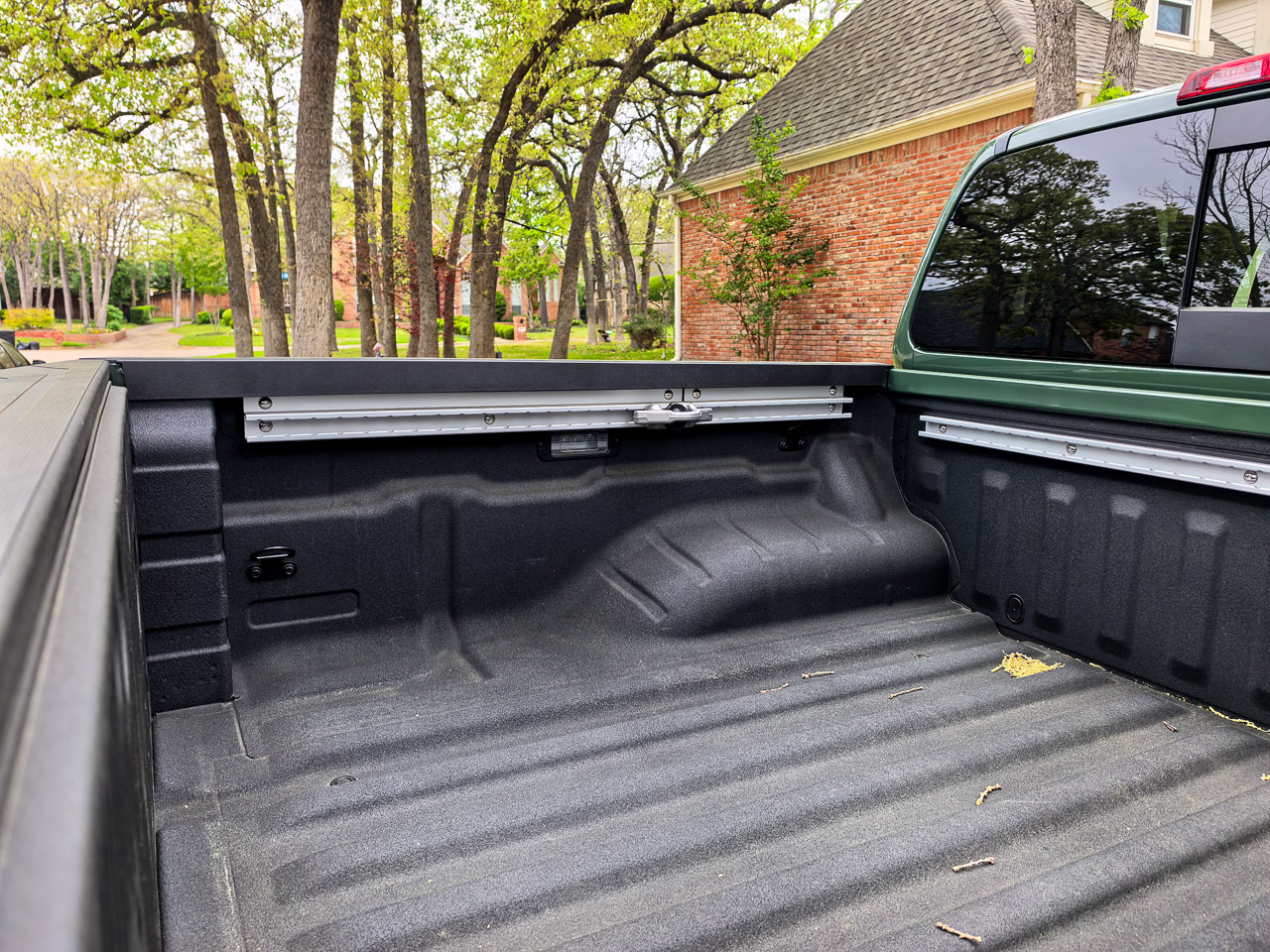
The real daily-driver flex is the Home Depot and grocery run. A full sheet of plywood lays flat in the 6-foot bed without hanging over the tailgate. A Costco haul that would require Tetris-level stacking in an SUV cargo area just sits in the bed, secured by the Utili-Track cleats. Two bikes, a cooler, and a bag of charcoal for a Saturday cookout? You don’t even need to fold the rear seats.
The available 6-foot bed behind a crew cab seals the deal. Most competitors force you to choose between crew cab room and a usable bed length. The Frontier gives you both, which matters enormously if your weekends involve lumber runs, bike racks, camping gear, or anything that won’t fit in a 5-foot box.
The Competition, Honestly
The Toyota Tacoma is the default choice in this segment, and for good reason: excellent resale value, a massive aftermarket ecosystem, and a turbocharged hybrid powertrain that delivers better fuel economy. But as a daily driver, the Tacoma feels like a high-strung turbo simulator. The turbocharged four-cylinder is efficient but adds mechanical complexity the Frontier avoids entirely. And while the Tacoma’s hybrid numbers win on the EPA sticker, the Frontier’s naturally aspirated V6 will never present you with a $5,000 battery replacement bill a decade from now. That long-term cost of ownership argument matters for buyers planning to keep a truck past the warranty window. The Tacoma’s power delivery also has a character that requires acclimation. The Tacoma’s interior is more refined, the infotainment is slicker, and the TRD Pro trim offers factory-installed Fox suspension. It also costs more at every comparable trim level.
The Ford Ranger brings a polished interior, good highway manners, and the Ranger Raptor variant for buyers who want more performance. The Ranger’s turbocharged four-cylinder is efficient but doesn’t match the Frontier’s V6 for outright throttle response. Pricing sits between the Frontier and Tacoma for most trims.
The Chevy Colorado ZR2 is the enthusiast’s choice, with multimatic DSSV dampers that deliver remarkable body control across all surfaces. The turbocharged 2.7L four-cylinder is potent and responsive. Interior quality is good, the tech stack is modern, and the ZR2’s on-road manners are the best in class. It’s also the most expensive standard competitor before you get to the Ranger Raptor.
Here’s a pricing comparison that tells the story:
| Truck | Off-Road Trim MSRP | Engine | HP |
|---|---|---|---|
| Nissan Frontier Pro-4X | $41,870 | 3.8L NA V6 | 310 |
| Toyota Tacoma TRD Off-Road (auto) | $43,515 | 2.4L Turbo-4 | 278 |
| Chevy Colorado Z71 | $44,600 | 2.7L Turbo-4 | 310 |
| Ford Ranger Lariat | $44,995 | 2.3L Turbo-4 | 270 |
| Ford Ranger Raptor | $60,000+ | 3.0L Twin-Turbo V6 | 405 |
The Frontier feels like a machine: linear, heavy, and predictable. It undercuts all of them on price and matches or beats them on raw powertrain simplicity. If mechanical straightforwardness, V6 character, and value matter to you more than cutting-edge tech or segment-leading interior materials, the Pro-4X makes a compelling case for your driveway.
Towing and the “Gear Fail”
The Frontier’s towing ceiling reaches 7,150 pounds in King Cab 4×2 configuration. The Crew Cab 4×4 Pro-4X is rated for approximately 6,760 pounds, which handles most boat trailers, utility trailers, and mid-weight recreational loads without issue. It feels stable under load, and the V6 doesn’t feel strained at highway speeds. A Class IV trailer hitch with wiring harness comes in the Pro Convenience Package.
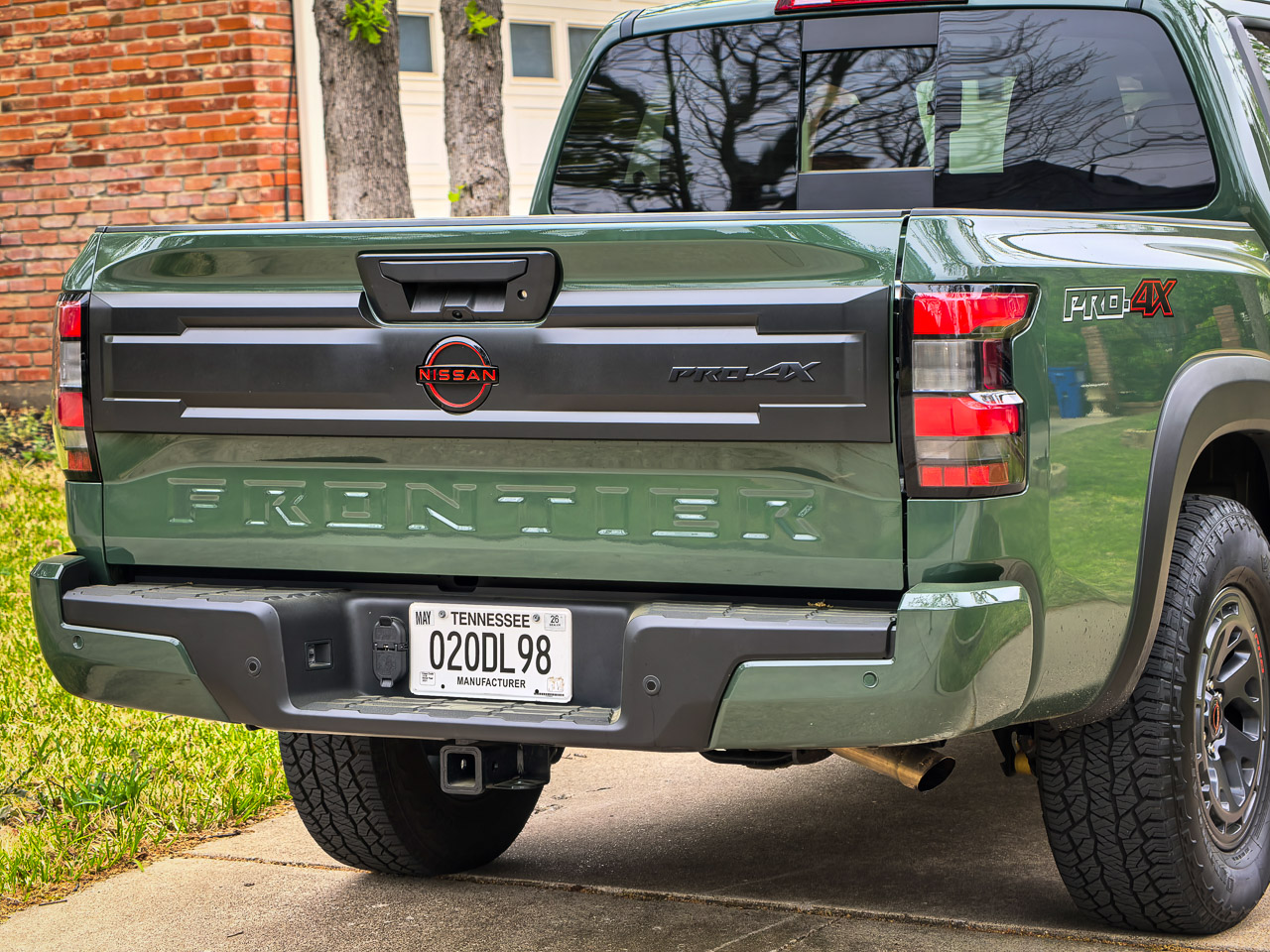
However, there is a glaring omission. The Frontier lacks a factory-integrated trailer brake controller. Even in 2026, you still have to install an aftermarket unit. If you’re a weekend boater backing down a ramp or a DIYer hauling a dump trailer from the hardware store, you’ll need to budget for an aftermarket controller and the wiring time that comes with it. At this price point, for a truck marketed toward the “Pro” buyer, that’s a significant miss Nissan should address.
Payload capacity sits in the competitive midrange for the segment. The 6-foot bed option gives the Frontier a real advantage for hauling oversized items that competitors with shorter standard beds can’t accommodate as easily.
Who This Truck Is For
The Frontier Pro-4X is best suited for buyers who want a capable, straightforward midsize truck that earns its keep in the driveway, not on the trail. Commuters who want something that feels purpose-built without feeling intimidating. Suburban families who need crew cab room and a usable bed length in one package. Weekend warriors who tow a small boat or haul gear to the lake. Anyone who values mechanical simplicity and long-term reliability over turbo engines, hybrid systems, or touchscreen-dependent controls.
It’s also worth serious consideration if you’ve been priced out of the Tacoma TRD Pro or Colorado ZR2 but still want the peace of mind that comes with over-built hardware on every road surface your daily life throws at you.
Skip it if you prioritize fuel economy above all else (the Tacoma hybrid is more efficient), if you want the most refined interior in the segment (the Colorado and Ranger both polish up nicer), or if rear seat legroom is non-negotiable for adult passengers.
The Verdict: The Cast Iron Skillet
The 2026 Nissan Frontier Pro-4X is the “Cast Iron Skillet” of trucks. It’s heavy, it’s old-school, and it requires a bit more effort to live with in the city. But like that skillet, it’s the tool that sits on your stove (or in your driveway) every single day because it’s the most reliable thing you own.
The V6 is strong, smooth, and proven. The Bilstein suspension rides better on asphalt than it has any right to. The physical controls are a daily-use advantage that doesn’t fade after the novelty period. And the value equation, especially with Nissan’s typical incentive programs, is the strongest in the segment.
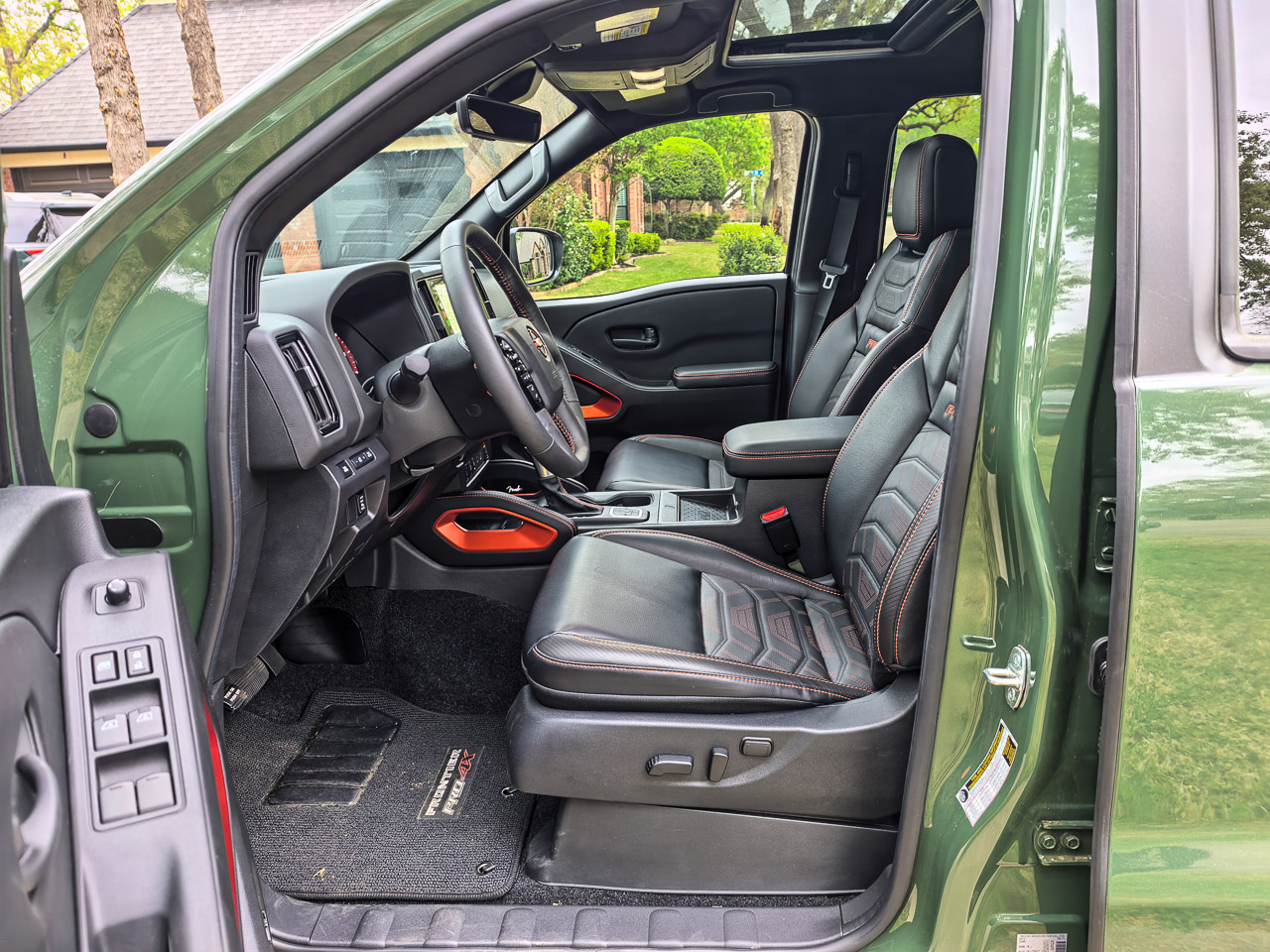
It’s not perfect. The steering is heavy, the rear seat is tight, the interior doesn’t match the class leaders for material quality, and the absence of an integrated brake controller is a genuine omission. These are known quantities, not hidden flaws. You can test drive a Pro-4X for fifteen minutes and know exactly whether those trade-offs work for your life.
At $48,735 as-tested, it undercuts several “high-performance” rivals by nearly $12,000. For the buyer who values longevity and physical buttons over turbo-lag and touchscreens, the Frontier is the only logical choice left on the market.
For a lot of buyers, it will be.
Final Rating: 8/10
Vincent’s Verdict: “In an era of disposable tech, the Frontier is a refreshing reminder that sometimes the best tool for the job is the one that simply works.”
FAQ
Is it reliable?
With no turbo or hybrid batteries to fail, the 3.8L V6 is widely considered one of the most reliable powertrains in the segment. It pairs with a conventional 9-speed automatic rather than a CVT, and Nissan backs it with a 5-year/60,000-mile powertrain warranty. Fewer complex systems generally translate to fewer failure points and lower long-term maintenance costs.
How does it compare to the top sellers?
It’s less “fancy” and thirstier on fuel, but it’s thousands of dollars cheaper and significantly easier to repair long-term. The Tacoma offers better fuel economy (especially in hybrid form), a more refined interior, stronger resale value, and a larger aftermarket parts ecosystem. The Frontier counters with a more powerful naturally aspirated V6 (310 hp vs. the Tacoma’s 278 hp turbo-four), lower pricing at every comparable trim level, and a mechanical simplicity that many buyers prefer. Where the Tacoma feels like a high-strung turbo simulator, the Frontier feels like a machine: linear, heavy, and predictable. Both are excellent trucks with different philosophies.
What’s the fuel economy of the 2026 Frontier Pro-4X?
The 4WD Crew Cab is rated at 16 city / 20 highway / 18 combined MPG. The 21-gallon fuel tank provides a theoretical highway range of around 420 miles. In our real-world testing with a week of grocery runs, school drop-offs, and highway passing, we averaged 16.4 MPG. Real-world numbers will vary based on driving conditions, load, and how heavy your right foot is during merges.
Can the Frontier Pro-4X tow a boat?
Yes. With a maximum towing capacity of up to 7,150 lbs (configuration dependent), the Frontier handles most recreational boat trailers, utility trailers, and mid-weight campers. The Pro Convenience Package adds a Class IV trailer hitch with wiring harness. Budget for an aftermarket brake controller if you tow regularly.
Is the Pro-4X worth it over the Pro-X?
The Pro-4X adds Bilstein shocks, Active Brake Limited Slip (ABLS), and steel skid plates that the Pro-X does not include. For a daily driver, ABLS is the real differentiator: it provides instant, automatic traction in rain and snow by braking a spinning wheel and redirecting torque to the wheel with grip. You never have to push a button or engage a locker. It just works, every time you hit a wet on-ramp or an icy intersection. Combined with better ride quality over rough roads and undercarriage protection from urban hazards, the Pro-4X justifies the price difference for anyone who commutes through four seasons.
Can it fit a 6-foot bed?
Yes. Nissan is one of the few brands still offering a Crew Cab with a Long Bed configuration (on the SV and SL trims). Most competitors force you to choose between crew cab room and a usable bed length. The Frontier gives you both, which matters enormously if your weekends involve lumber runs, bike racks, camping gear, or anything that won’t fit in a 5-foot box.